Saga Heavy Machine Co.
Stump Grinding in Western Massachusetts — Saga Heavy Machine Co. job site
All Services

Stump Grinding in Western MA

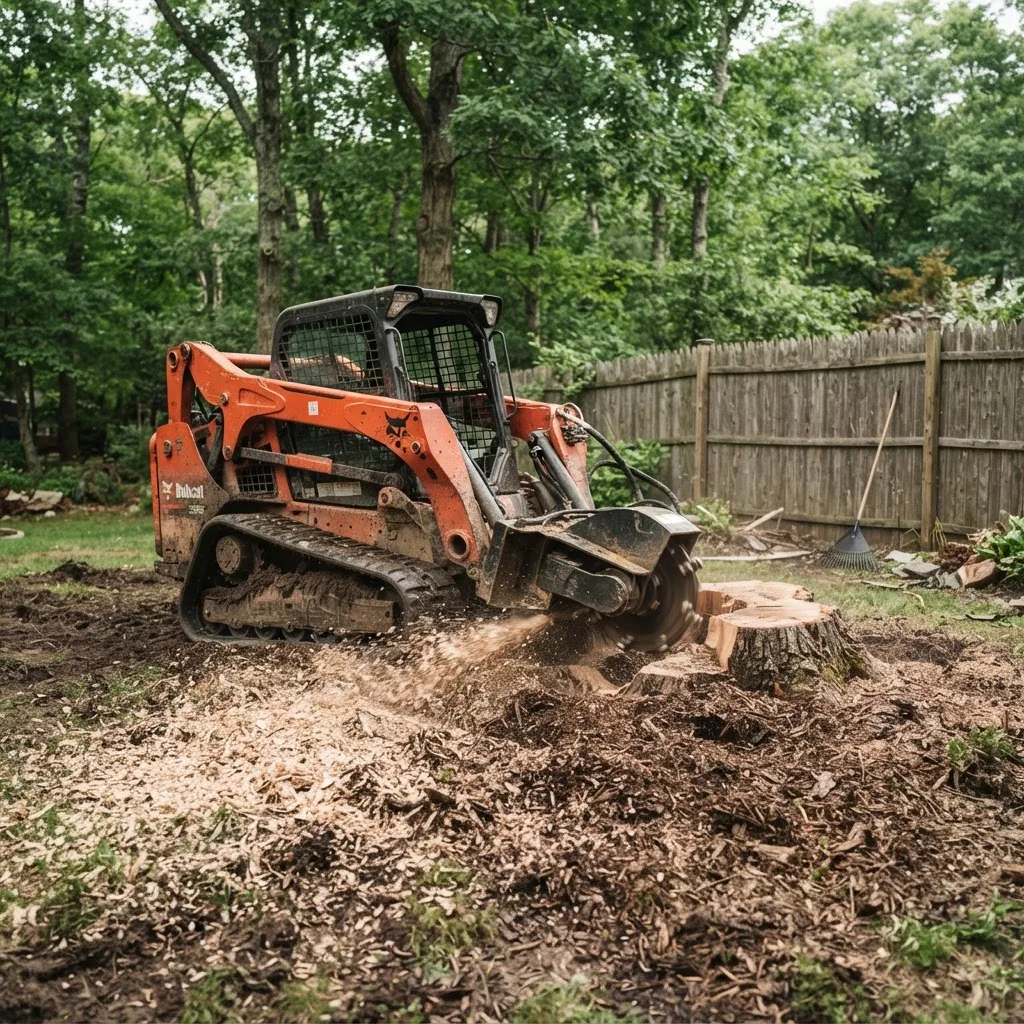
Stumps ground out below grade instead of left to rot. We grind close to structures and fence lines, backfill the hole with the chips, and leave ground you can mow, build, or plant over — from single stumps in a Springfield back yard to full clearing cleanup in Belchertown.

What's included

  • Stump grinding below grade
  • Surface root removal
  • Tight-access and near-structure grinding
  • Post-clearing stump cleanup
  • Chip backfill and site cleanup

Grinding vs. full stump removal

Grinding chews the stump into chips from the top down, leaving the deeper root mass in place to decay naturally. It is faster, far less destructive to the surrounding lawn, and leaves a hole you can backfill immediately. Full excavation pulls the entire root ball out with a machine, which leaves a large crater and heavy soil disturbance but removes essentially all of the wood. For the overwhelming majority of residential jobs — lawn restoration, fence lines, landscaping, replanting nearby — grinding is the correct choice. Full removal makes sense mainly when a foundation, pool, septic system, or utility trench is going in exactly where the stump is and the wood genuinely cannot stay.

How deep is 'below grade'

The practical answer depends on what happens next. For lawn restoration, grinding several inches below grade is generally enough to let you spread soil, seed, and mow over the spot without hitting wood. For new landscaping beds or planting, you want more depth so roots have somewhere to go. For construction, deeper still — and often full removal instead. Grinding depth is also limited by real physical constraints: rocks in the root zone, buried utilities, irrigation lines, and how close the stump sits to a foundation or wall. We would rather set depth expectations honestly on site than promise a number that a boulder makes impossible.

What happens to the chips

Grinding a stump produces a surprising volume of chips, usually more than people expect. The default is to backfill the hole with them, which is free, immediate, and fine for most situations — the pile will settle over the following months as the material breaks down, so it is normal to top it with soil later. If you want clean soil in that spot right away, the chips need to be raked out and hauled off, which is extra work and disposal. Some customers keep the chips for trails or beds. Worth knowing: fresh wood chips temporarily tie up nitrogen as they decompose, so seeding directly into pure chip backfill often disappoints. Topping with a few inches of loam gives much better results.

Access, utilities, and near-structure work

Access is usually the deciding factor on stump work. A stump in an open front yard is straightforward. The same stump behind a fence with a narrow gate, or wedged between a garage and a property line, is a different job — that is where a compact machine earns its keep. Before grinding we want utilities marked. Massachusetts requires a Dig Safe call before excavation work, and stumps sit exactly where shallow gas, water, electric, and irrigation lines tend to run. Private lines that Dig Safe does not cover — invisible dog fence, landscape lighting, sprinkler heads, septic components — are worth pointing out to us, because those are the ones that get hit.

What affects the price

Every site is different, so we quote after seeing the property rather than publishing a rate that will not match your job. These are the factors that move the number:

  • Stump diameter measured at grade — the single biggest driver
  • Number of stumps, since additional stumps on one visit cost far less than separate trips
  • How deep it needs to be ground for what you are doing next
  • Access: open lawn vs. narrow gates, slopes, or tight side yards
  • Rocks, gravel, or buried debris in the root zone, which are hard on cutting teeth
  • Proximity to foundations, fences, utilities, and irrigation
  • Whether chips stay as backfill or get hauled away
  • Surface root runs that need grinding beyond the stump itself

Stump Grinding FAQs

How much does stump grinding cost in Western Massachusetts?
Pricing depends mostly on stump diameter, how many stumps you have, and how hard they are to reach. Several stumps ground on a single visit cost much less each than the same stumps done on separate trips, since most of the cost is getting the machine there. Rocky soil, tight access, and haul-away of the chips all add. We give a firm number after seeing the stumps rather than a per-inch rate that ignores access.
How deep do you grind stumps?
Deep enough for what you are doing next. Lawn restoration typically needs several inches below grade so you can spread loam, seed, and mow without hitting wood. New planting beds want more. Actual depth is limited by rocks, buried utilities, and how close the stump is to structures, so we set expectations on site rather than promising a fixed number.
Can I plant grass or a new tree where the stump was?
Grass, yes — but top the chip backfill with a few inches of loam first. Fresh chips tie up nitrogen while they decompose, so seed sown directly into pure chip fill tends to come in poorly. For a new tree in the same spot, it is better to remove the chips and backfill with soil, or plant a few feet away, since the decaying root mass and chips make a poor rooting environment.
Will grinding damage my lawn?
Grinding is far gentler than excavating a stump out, but a machine still has to reach the stump, so expect some tire tracks and turf wear on the path in — more if the ground is soft. We work off the driest practical approach and clean up after. If the ground is saturated, waiting for it to firm up produces a much better result.
Do you grind surface roots too?
Often, yes. Large roots radiating from the stump can be ground down where they interfere with mowing or landscaping. That said, aggressively grinding roots close to a living tree can harm it, so on shared root systems we are selective rather than thorough.

Need stump grinding?

Tell us about your site and we'll get you a straight estimate.

Request a Quote